
What to Do If Your Telegram Channel Got Botted
You wake up, check your Telegram channel, and something looks wrong. Your subscriber count jumped by thousands overnight, but your view count barely moved. Your analytics show a flood of new accounts with no profile photos, random character names, and zero engagement. Your channel has been botted. This guide walks you through exactly what happened, how to confirm it, how to clean it up, and how to make sure it does not happen again.
What Are Bot Subscribers on Telegram?
Bot subscribers are fake or automated Telegram accounts that join channels without any genuine interest in the content. These accounts are typically mass-created using virtual phone numbers, often registered in large quantities from specific regions. They have predictable characteristics: generic or randomly generated names, no profile photos, no bio information, no Telegram Premium status, and little to no activity after joining.
Bot subscribers are not the same as Telegram Bots (the official @BotFather-created bots that provide useful automated services). Bot subscribers are impersonating real users. They inflate your subscriber count without adding any real value, and in most cases, they actively harm your channel's health.
Understanding the distinction matters because the response strategy depends on whether bots joined your channel intentionally (as part of a service you purchased) or maliciously (as an attack from a competitor or troll). Both scenarios require action, but the urgency, approach, and long-term implications differ significantly.
Why Would Someone Bot Your Channel?
Bot attacks on Telegram channels are more common than most channel owners realize. The motivations behind them fall into several categories, and understanding the "why" helps you respond more effectively.
Competitor Sabotage
The most common reason for unwanted bot subscribers is competitor sabotage. A rival channel owner floods your channel with bots to destroy your engagement metrics. When your subscriber count jumps from 5,000 to 15,000 but your views stay at 1,500, your engagement rate drops from 30% to 10%. This makes your channel look fake to potential advertisers, partners, and real subscribers.
Advertisers routinely check engagement rates before purchasing ad placements. A channel with 15,000 subscribers and 1,500 views per post (10% engagement) looks far less attractive than a channel with 5,000 subscribers and 1,500 views (30% engagement), even though the actual reach is identical. The competitor wins by making your genuine performance look artificially inflated.
Extortion and Ransom
Some attackers bot your channel and then contact you offering to "fix" the problem for a fee. They know that cleaning bots manually is painful and time-consuming, so they bet on you paying them to stop the attack or reverse it. This is essentially a digital extortion scheme.
Reputation Damage
In niches where credibility matters (finance, trading signals, news), having a botted channel can permanently damage your reputation. If your audience or peers notice the sudden subscriber spike and suspect you bought fake followers, the trust erosion is difficult to reverse, even after you clean the bots out.
Testing and Collateral Damage
Sometimes bot attacks are not targeted at you specifically. Bot networks occasionally flood random channels as part of testing their infrastructure or distributing bots across many targets to avoid detection. Your channel may simply have been in the wrong place at the wrong time.
Important: If someone contacts you after a bot attack offering to fix it for money, do not pay them. This rewards the behavior and marks you as a target for future attacks. Handle the cleanup yourself using the methods described below.
How to Tell If Your Channel Has Been Botted
Identifying a bot attack early minimizes the damage. The sooner you detect it, the faster you can act. Here are the key indicators that your channel has been compromised by fake subscribers.
Sudden Subscriber Spike with No Explanation
The most obvious sign is a sharp, unexplained increase in subscriber count. If you did not run any promotion, did not get mentioned by a large channel, and did not publish viral content, but your subscriber count jumped by hundreds or thousands in a short period, bots are the most likely explanation. Check your channel analytics for the exact timing of the spike to confirm it was not organic.
Engagement Rate Drops Dramatically
Your post views, reactions, and forwards should scale roughly with your subscriber count. If your channel had 5,000 subscribers with 2,000 average views per post (40% view rate) and then jumped to 12,000 subscribers while views stayed at 2,000 (now 16.7%), bots are diluting your metrics. Real subscriber scaling produces proportional engagement increases. Bot inflation does not.
Suspicious Account Profiles
If you have a linked discussion group, check recent joiners. Bot accounts share common characteristics:
- No profile photo: Most bot accounts skip this step entirely
- Random or generated names: Names using unusual character sets (Arabic, Chinese, or mixed scripts) that do not match your channel's target audience
- No username: Bot accounts frequently lack a @username
- No Telegram Premium: Virtually zero bot accounts have Premium subscriptions
- Same registration period: Many bot accounts are created in the same timeframe, often visible through analytics tools
- No bio or about section: Empty profiles with zero personalization
Abnormal Join Patterns
Real subscribers join channels gradually throughout the day, with natural peaks during high-activity hours in your target time zones. Bot attacks typically show a different pattern: hundreds or thousands of joins concentrated in a narrow time window, often during off-peak hours. If your analytics show 3,000 new subscribers between 3:00 AM and 4:00 AM in a single burst, that is not organic scaling.
View-to-Subscriber Ratio Collapses
Track your view-to-subscriber ratio over time. A healthy Telegram channel typically maintains a view rate between 20% and 60%, depending on the niche and posting frequency. If this ratio suddenly drops by half or more without any change in your content strategy, bot subscribers are the most likely cause. This metric is one of the most reliable diagnostic tools because it is difficult to fake: bots join but they do not view posts.
Quick diagnostic checklist: Unexplained subscriber spike + stable view count + low-quality new profiles + burst join pattern = your channel has been botted. If three or more of these indicators are present, proceed to cleanup immediately.
Immediate Steps When You Discover Bots
Once you have confirmed that your channel has been botted, act quickly. The longer bot accounts remain on your channel, the more damage they do to your engagement metrics, advertiser relationships, and algorithmic positioning.
1. Document Everything
Before you start removing anything, document the current state. Take screenshots of your subscriber count, recent analytics, view rates, and any suspicious accounts you have identified. If you have an advertising partnership or are in discussions with potential advertisers, this documentation proves that the bot influx was an external attack, not something you purchased.
Record the exact date and time the spike occurred, the number of subscribers before and after, and any messages or contacts you received from unknown parties around the same time.
2. Check Your Invite Links
Go to your channel settings and review all active invite links. If you use multiple invite links for different promotion sources, check which link the bots used to join. This tells you whether the attack came through a public link, a specific promotional link that was compromised, or a link that was shared somewhere you did not intend.
If you identify the compromised link, revoke it immediately and create a new one. If you are unsure which link was used, consider revoking all existing invite links and generating fresh ones as a precaution.
3. Temporarily Restrict Joining (If Possible)
If the bot attack is still actively adding subscribers, consider temporarily making your channel private or enabling join request approval. This stops the bleeding while you work on cleanup. For public channels, you can temporarily switch to a private channel with an invite link, then switch back to public once the attack subsides.
This step is optional and depends on the severity of the attack. If the bot influx has already stopped, you can skip directly to the removal phase.
4. Do Not Panic-Post About It
Resist the urge to post a message on your channel explaining the bot attack. While transparency is generally good, a public announcement draws attention to the inflated numbers and may cause real subscribers to question your channel's legitimacy. Handle the cleanup quietly and efficiently. If advertisers or partners ask, explain privately with the documentation you prepared.
How to Remove Bot Subscribers from Your Channel
Removing bot subscribers is the most labor-intensive part of the recovery process, but it is essential. Leaving bots on your channel permanently depresses your engagement metrics and signals to both Telegram's systems and external observers that your audience is not genuine.
Method 1: Telegram's Built-In Recent Actions
For channels with linked discussion groups, Telegram provides a list of recent member actions. You can view who joined recently and manually remove suspicious accounts. This method works for small-scale bot attacks (a few hundred accounts) but becomes impractical for larger ones.
Go to your channel settings, open the subscriber list, sort by recently joined, and start reviewing profiles. Remove any account that matches the bot characteristics described above: no photo, random name, no username, no Premium, empty profile.
Method 2: Third-Party Cleanup Tools
For larger bot attacks, manual removal is not realistic. Several third-party services and tools specialize in identifying and removing bot subscribers from Telegram channels. These tools analyze your subscriber list against known bot patterns, flag suspicious accounts, and either remove them automatically or present a list for your approval.
When choosing a cleanup tool, prioritize ones that:
- Do not require full admin access to your channel (read-only access for scanning, then targeted removal)
- Use multiple detection criteria, not just "no profile photo"
- Allow you to review flagged accounts before deletion
- Have a track record and reviews from other channel owners
Method 3: Telegram's Automatic Bot Purges
Telegram periodically conducts platform-wide purges of fake and bot accounts. When this happens, bot subscribers are automatically removed from all channels. However, these purges are unpredictable: they might happen weeks or months after your channel was attacked. Relying solely on Telegram's purges means living with damaged metrics in the meantime.
You will notice a Telegram purge when your subscriber count drops suddenly across a period of hours, typically accompanied by reports from other channel owners experiencing the same drop. These purges are normal and healthy for the platform. If your subscriber count drops during a purge, it means the system is working as intended.
Method 4: Channel Recreation (Last Resort)
In extreme cases where a channel has been so heavily botted that the legitimate subscriber percentage is very low, some channel owners choose to create a new channel and migrate their real audience. This is a drastic measure and should only be considered when bot subscribers outnumber real ones by a significant margin (for example, 90% bots), cleanup tools cannot effectively separate real from fake accounts, or the channel's reputation has been irreparably damaged.
If you go this route, post a final message on the old channel directing real subscribers to the new one, pin the migration message, and keep the old channel active for at least 30 days to give everyone time to switch. You will lose some legitimate subscribers in the process, but you start fresh with a clean, credible audience base.
How Bot Attacks Affect Your Channel Analytics
Understanding the analytical impact of a bot attack helps you communicate with advertisers, track your recovery, and benchmark your channel's real performance. Bot subscribers distort nearly every metric that matters.
View Rate Depression
This is the most visible and damaging effect. View rate (views per post divided by total subscribers) is the primary metric advertisers use to evaluate channel quality. A channel with 10,000 real subscribers and 4,000 views per post has a 40% view rate, excellent by any standard. Add 20,000 bot subscribers and the same channel now shows a 13.3% view rate with 30,000 total subscribers. The channel's actual performance has not changed, but it looks dramatically worse on paper.
Engagement Rate Distortion
Reactions, comments, forwards, and link clicks are all calculated relative to subscriber count. When bot subscribers inflate the denominator, every engagement metric looks worse. A post that gets 500 reactions out of 10,000 subscribers (5% engagement) drops to 1.67% engagement with 30,000 subscribers. Again, nothing actually changed except the math.
Scaling Trend Corruption
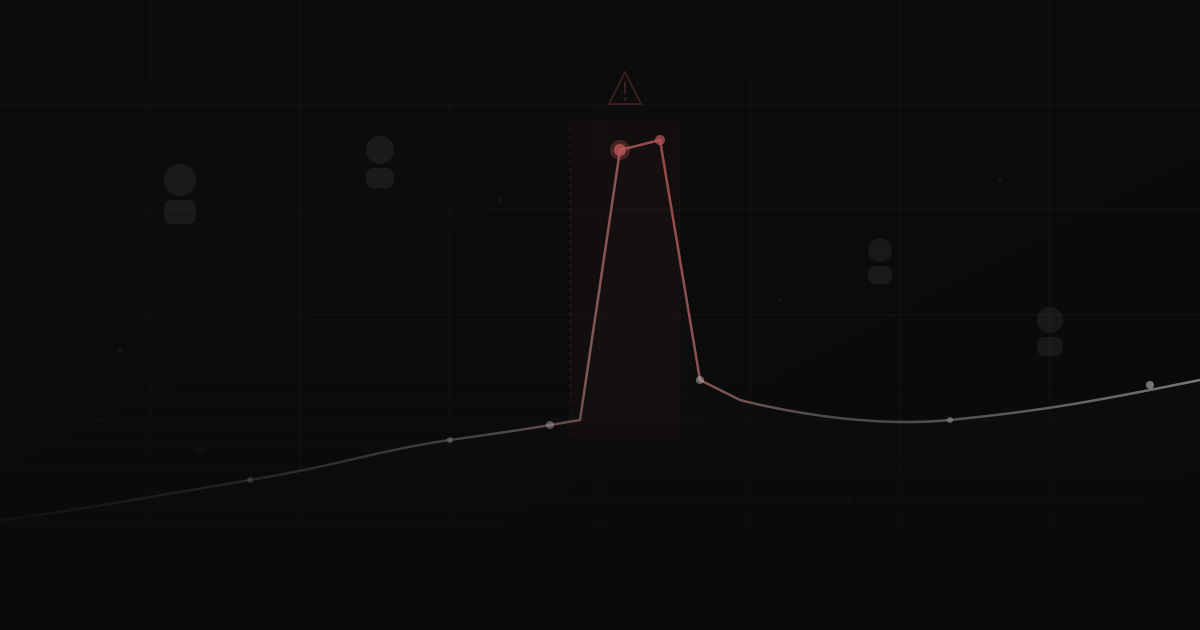
Your subscriber scaling chart suddenly shows a spike that has nothing to do with your strategy. This makes it harder to evaluate which scaling tactics are actually working, because the signal is buried in noise. After cleaning bots, your chart will show a corresponding drop, which can also look alarming to anyone reviewing your analytics without context. Keep your documentation ready to explain these anomalies.
Advertiser Trust Erosion
Sophisticated advertisers and media buyers know how to spot botted channels. They look at view-to-subscriber ratios, engagement rates, subscriber scaling patterns, and audience demographics. A bot attack creates red flags across all of these indicators. Even after cleanup, the anomalous spike and drop in your subscriber history can raise questions. Proactive communication with current advertisers, backed by your documentation, is essential for maintaining those relationships.
For a deeper understanding of channel metrics and how to track them properly, read our full guide on Telegram channel analytics.
How to Protect Your Channel from Future Bot Attacks
Prevention is always easier than cleanup. While you cannot make your channel completely immune to bot attacks, you can significantly reduce the risk and detect attacks faster when they do occur.
Monitor Your Subscriber Scaling Daily
Set up a routine of checking your subscriber count and view rates at the same time every day. When you know your channel's normal scaling pattern (for example, 20-50 new subscribers per day), an anomaly like 2,000 new subscribers overnight is immediately obvious. Early detection means faster response and less damage.
Floqal Analytics provides free monitoring of any Telegram channel, including subscriber scaling tracking and engagement rate calculation, so you can spot anomalies the moment they happen instead of discovering them days later.
Use Invite Links Strategically
Instead of relying on a single public invite link, create multiple invite links for different promotion channels and track their performance individually. This approach has two benefits: it helps you identify which promotion sources drive the most important subscribers, and it makes it easy to identify and revoke a compromised link without disrupting your other acquisition channels.
Label each invite link clearly (for example, "Twitter Bio Link," "Reddit Post March," "Partner Channel A") so you can trace the source of any suspicious influx immediately.
Enable Slow Mode in Discussion Groups
If your channel has a linked discussion group, enabling slow mode limits how frequently users can send messages. While this does not prevent bots from joining your channel, it reduces the impact of bot spam in your discussion group, which is often a secondary target in bot attacks.
Consider Join Request Approval
For channels where audience quality matters more than rapid scaling, enabling join request approval gives you a manual filter. Every new subscriber must be approved before they can access your content. This is impractical for large-scale consumer channels, but it works well for premium, niche, or paid channels where each subscriber represents significant value.
Maintain Clean Analytics History
Document your channel's normal performance metrics (average daily scaling, view rate, engagement rate) on a regular basis. This baseline makes anomalies easier to spot and gives you evidence to present to advertisers if an attack occurs. A channel owner who can show consistent 35% view rates before and after a bot spike, with documentation of the attack and cleanup, maintains credibility far better than one who cannot.
Build Relationships with Your Real Audience
An engaged, loyal audience is your best defense against the reputation damage that bot attacks cause. When your real subscribers regularly interact with your content through reactions, comments, and forwards, the community itself becomes proof of authenticity. A channel where every post has active, genuine discussion in the comments is obviously real, regardless of what the subscriber number says. Our guide on scaling your Telegram channel covers engagement strategies in detail.
Should You Use Bot Subscribers Intentionally?
This is a complicated question that deserves an honest answer. Bot subscribers used intentionally for social proof serve a fundamentally different purpose than a bot attack.
The Social Proof Argument
New channels face a cold-start problem: nobody wants to be the first subscriber. A channel with 47 subscribers looks abandoned, even if the content is excellent. A channel with 5,000 subscribers looks established and worth checking out. This is the same psychology that drives restaurants to keep their dining rooms visible from the street and nightclubs to maintain queues outside the door.
Some channel owners use bot subscriber services to establish initial credibility, then transition to organic and targeted scaling methods once the channel has enough social proof to attract real subscribers on its own. When done correctly (gradual delivery, non-drop guarantees, used only as a starting base), this approach can accelerate early scaling without the negative effects of a bot attack.
The Critical Differences
Using bot subscribers intentionally differs from being attacked in several ways:
- You control the timing and volume: Gradual, controlled delivery looks natural. A sudden spike of 20,000 bots does not.
- You plan for it in your metrics: You know your real subscriber count and can calculate your true engagement rate. An attack blindsides you.
- You combine it with real scaling: Intentional bot subscribers are a foundation, not an endpoint. The goal is to attract enough real subscribers that the bots become a diminishing percentage of your total audience.
- Quality matters: Reputable services deliver accounts that stay and do not trigger Telegram's purge systems. Attacks use cheap, easily detectable bots.
The bottom line: Intentional, controlled use of bot subscribers for social proof is a scaling tactic. Being botted by an attacker is sabotage. The difference is control, intent, and execution quality.
How Botting Affects Monetization and Ad Revenue
If you monetize your Telegram channel through advertising, sponsored posts, or affiliate partnerships, a bot attack has direct financial consequences. Understanding these impacts helps you quantify the damage and prioritize cleanup.
CPM and Pricing Impact
Most Telegram advertising is priced based on subscriber count, view count, or engagement rate. A botted channel creates a misleading picture for all three metrics. Advertisers who discover that a significant portion of your subscribers are bots will demand refunds, lower rates, or cancel partnerships entirely. Even if they do not discover it, the depressed engagement rate makes your channel less competitive in the marketplace.
A channel with 50,000 subscribers and 8% view rate commands lower ad rates than a channel with 15,000 subscribers and 40% view rate, because experienced buyers know that view count is what actually matters. Cleaning bots restores your true engagement rate and makes your channel more attractive to quality advertisers, not less.
Telegram Stars and Premium Monetization
Telegram's native monetization features, including Telegram Stars and the built-in wallet system, are tied to genuine engagement and real user interactions. Bot subscribers do not purchase Stars, do not tip, and do not interact with paid content. A channel relying on these monetization methods gains nothing from bot subscribers and loses credibility if the inflation is noticed.
Affiliate and Referral Revenue
Affiliate earnings depend on real people clicking links and making purchases. Bot subscribers never convert. If your affiliate partners track conversion rates relative to your reported audience size, a botted subscriber base makes your conversion rate look terrible, potentially costing you affiliate partnerships or preferred commission tiers.
Long-Term Revenue Recovery
The good news is that revenue recovery after a bot cleanup is usually straightforward. Once you remove the fake subscribers, your engagement metrics return to their genuine levels. A channel that goes from 50,000 subscribers (35,000 bots) with 8% engagement to 15,000 subscribers with 40% engagement is actually in a stronger commercial position after cleanup than before the attack. The numbers are smaller, but they are real, and advertisers value authenticity. For detailed monetization strategies, explore our guide on how to make money with Telegram channels.
Recovery Plan: Rebuilding After a Bot Attack
Cleanup is only half the battle. After removing bot subscribers, you need a recovery plan that restores your channel's metrics, reputation, and scaling trajectory to pre-attack levels.
Phase 1: Stabilize (First 7 Days)
Immediately after cleanup, your subscriber count will be lower than before the attack (because it should be). Your engagement rate should be higher, reflecting your real audience. During this phase:
- Monitor daily for any continued bot activity. Some attacks come in waves.
- Verify that all invite links are secure and no compromised links remain active.
- Resume your normal posting schedule to signal to your real audience that the channel is active and healthy.
- Update any public-facing metrics or media kits with your current, accurate numbers.
Phase 2: Rebuild Engagement (Days 7-30)
Focus on strengthening your relationship with your real subscriber base. This is not the time to aggressively pursue new subscribers. Instead:
- Increase content quality and posting consistency to reinforce value for existing subscribers.
- Run polls, Q&A sessions, and interactive content to boost visible engagement metrics.
- Analyze your content performance with the clean dataset. Without bot noise, your analytics now accurately reflect what your real audience responds to.
- Reach out to advertisers and partners proactively, if applicable, with your cleaned analytics showing strong engagement rates.
Phase 3: Resume Scaling (Day 30+)
Once your metrics are stable and your engagement rates reflect genuine audience behavior, resume active scaling efforts:
- Restart targeted outreach campaigns with proper audience filtering. Volume DM campaigns paired with Channel Clone let you reach real, relevant users from active channels in your niche.
- Pursue cross-promotion partnerships with complementary channels.
- Cross-promote on other platforms where your audience is active.
- Consider Telegram business strategies that attract high-quality, engaged subscribers rather than maximizing raw subscriber count.
The goal of the recovery phase is not just to return to your pre-attack subscriber count, it is to build a healthier, more engaged channel than you had before. A bot attack, handled correctly, can be a forcing function that makes you more disciplined about audience quality, analytics monitoring, and scaling strategy.
Phase 4: Long-Term Monitoring
After recovery, maintain the monitoring habits you developed during the crisis. Continue tracking daily subscriber changes, weekly view rate trends, and monthly engagement benchmarks. Set up automated alerts if available. The best defense against future attacks is a monitoring system that catches anomalies within hours instead of days.
Key Takeaways
Getting botted is disruptive but recoverable. The channels that come out strongest are the ones that respond quickly, clean thoroughly, and use the experience to build better monitoring and scaling practices. Here is a summary of the critical action steps:
- Detect early: Monitor subscriber scaling and engagement rates daily. Anomalies should trigger immediate investigation.
- Document everything: Screenshots, analytics exports, and timestamps protect your reputation with advertisers and partners.
- Secure your links: Revoke compromised invite links immediately. Use labeled, source-specific links going forward.
- Clean aggressively: Remove bot subscribers using the most effective method available for the scale of the attack. Do not wait for Telegram's automatic purges.
- Communicate proactively: Brief advertisers and partners privately, backed by documentation. Do not announce the attack publicly on your channel.
- Rebuild with quality: Use the cleanup as a reset. Focus on engagement, content quality, and genuine audience scaling.
- Prevent recurrence: Implement daily monitoring, alert systems, and invite link management practices that catch future attacks early.
Your real audience, the subscribers who read your content, react to your posts, and share your channel with their networks, is what makes your channel worth protecting. Bot subscribers add nothing. Removing them and protecting against them is not damage control; it is an investment in the quality and credibility of your channel.
Frequently Asked Questions
How do I know if my Telegram channel has been botted?
The clearest signs are a sudden subscriber spike with no matching increase in post views, a sharp drop in engagement rate, and new accounts with no profile photos, random names, and no usernames. If your subscriber count jumped overnight but your views stayed the same, your channel has almost certainly been botted.
Can you remove bot subscribers from a Telegram channel?
Yes. For small attacks, you can manually remove suspicious accounts through your channel's subscriber list. For larger attacks, third-party cleanup tools can scan your subscriber list and flag bot accounts for removal. Telegram also runs periodic platform-wide purges that automatically remove detected bot accounts.
Why would someone bot my Telegram channel?
The most common reason is competitor sabotage. By flooding your channel with fake subscribers, a rival destroys your engagement rate, making your channel look fake to advertisers. Other reasons include extortion (attackers offer to fix the problem for a fee) and reputation damage in niches where credibility matters, like finance or trading signals.
Does having bot subscribers affect Telegram ad revenue?
Yes, significantly. Bot subscribers inflate your total count while contributing zero views or clicks, which drops your engagement rate. Advertisers price based on view rate and engagement quality. A channel with 50,000 subscribers and 8% view rate earns less per ad than a channel with 15,000 subscribers and 40% view rate. Cleaning bots restores your real metrics and ad value.
How long does it take to recover from a Telegram bot attack?
With prompt action, most channels recover within 30-60 days. The first week focuses on removing bots and stabilizing metrics. Days 7-30 are for rebuilding engagement with your real audience. After day 30, you can resume active scaling efforts. Using analytics tools to monitor daily subscriber changes helps catch future attacks within hours instead of days.
Need Help Scaling Your Channel the Right Way?
From targeted Member Scraping and Mass DMs to Ad Accounts and Channel Clone, Floqal helps you build a real, engaged Telegram audience.
Try Free Demo